
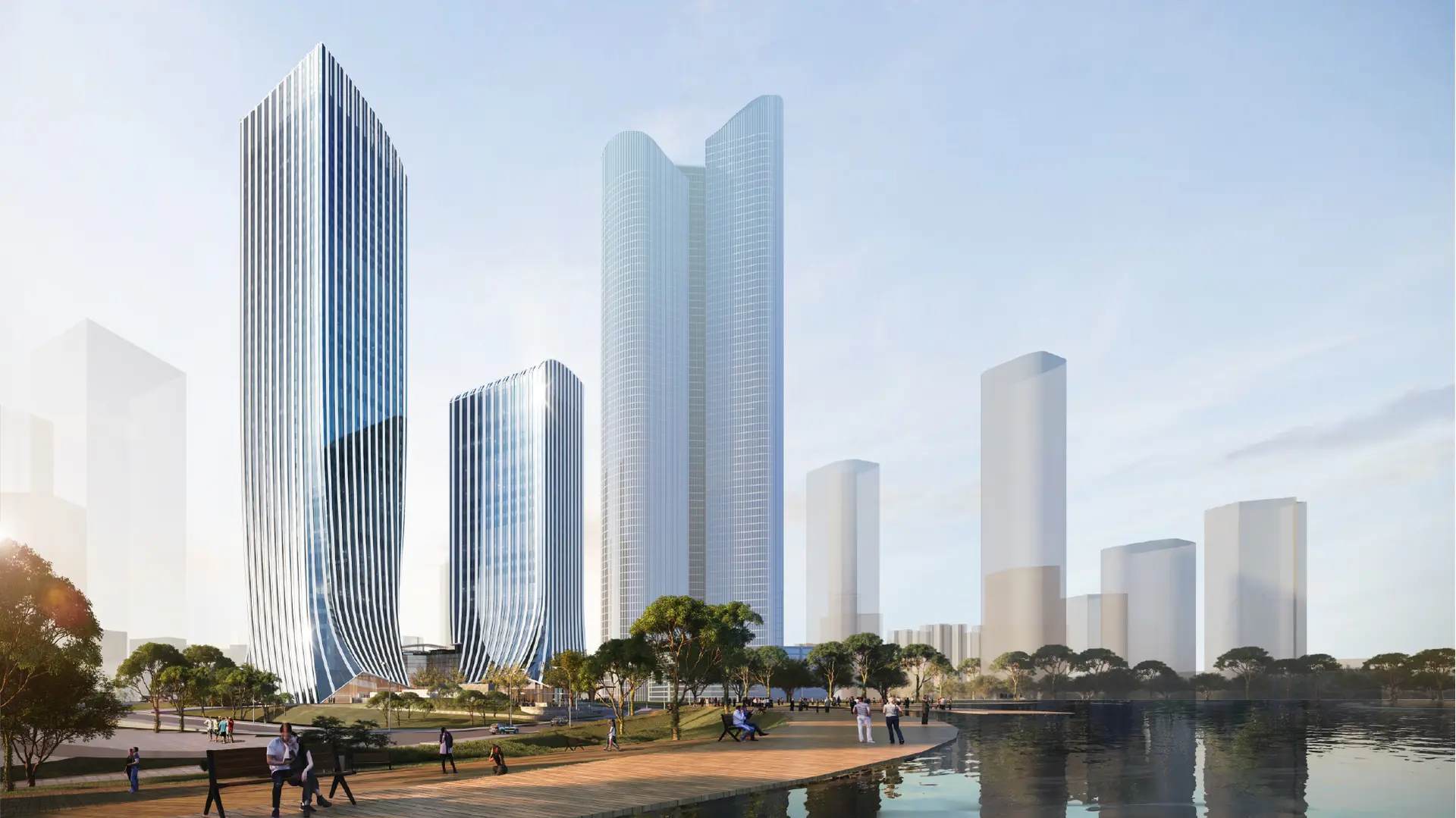
How the bespoke furniture behind a luxury resort moves from approved drawings to installed rooms — and what to verify before you place an order.
Banyan Tree Guangzhou Jiulong Lake was furnished by a China custom hotel furniture manufacturer, and the property is a useful place to start because almost everything a hotel buyer needs to understand is visible in it. The furniture was made to the project's own drawings rather than selected from a catalogue. It had to survive a humid subtropical climate. And it had to look deliberate in rooms that were composed as a whole, where a piece dimensioned to a standard module reads as an interruption.
Resorts are the hardest test for hotel furniture, because the commercial pressures of a city business hotel and the environmental pressures of a humid property arrive at the same time. Lobby and public area furniture is touched by thousands of guests in a season. Dining furniture is pulled, pushed and repositioned at every service. Bedroom casegoods are opened, closed and wiped down every day of the year. Both the guest-facing look and the housekeeping reality have to hold up at once.
This article starts with the project — what the property needed, which spaces the furniture had to serve, and what the package actually covers — and then widens out to what a China custom hotel furniture manufacturer does, how a bespoke package travels from drawings to installed rooms, and how to tell a factory from a trading office before you commit to an order.
Banyan Tree Guangzhou Jiulong Lake: What the Property Needed
The property is built around an idea that shapes every specification decision: nature meeting refined luxury. That combination sounds like a marketing line until it reaches the furniture schedule, where it turns into a set of hard constraints. A resort of this type has to feel calm at the guest's own pace and still stand up to a climate that is humid for most of the year.
Guangzhou sits in a subtropical zone, and a property surrounded by water and planting is exposed to moisture across every season. That single fact removes a long list of otherwise attractive options. Solid timber is dimensionally alive — it moves with moisture — so large surfaces are usually engineered rather than cut as a slab. Finishes that need specialist care are effectively finishes that routine housekeeping will damage. Upholstery has to be specified by how it will be used, not only by how it photographs.
The design language of the property imposes a second set of rules. Curved seating, mixed materials and warm timber tones are unforgiving of standard modules, because a curved sofa that is dimensioned to a catalogue will not follow the geometry of a room that was drawn as a single composition. In a project like this the furniture is not an accessory to the space — it is the space.
The spaces the furniture had to serve
Across the public areas of the property, the furniture programme reaches into the rooms where guests form their first and longest impressions:
- The entrance and arrival sequence, where the first impression is set before a guest reaches the front desk
- The lobby and its lounge seating, used all day and into the evening
- The all-day dining room, where tables and chairs are moved between every service
- The Chinese restaurant, with its round tables and upholstered seating
- Guest rooms and suites, where volume, repetition and consistency become the dominant issue
What the furniture package covers
Working through the public areas of the property, the package includes:
- Lounge and lobby seating — curved sofas, armchairs and coffee tables dimensioned to the plan rather than to a standard module
- Dining furniture — tables with upholstered chairs for the all-day dining room, and round tables with chairs for the Chinese restaurant
- Banquette and built-in seating, shaped to the geometry of each room rather than to a repeating unit
- Fixed furniture and wall panelling where the design called for a continuous surface between one element and the next
For a property of this size the same manufacturing scope extends to guest room furniture — beds, headboards, bedside pieces, seating, desks and casegoods — where the drawings-to-production process described later in this article applies in exactly the same way, room type by room type.
Two product families appear side by side in that list, and this is the point where the project stops being a single case study and becomes a working example of what the manufacturer on the other side of it actually does. Other resort and hotel work by the same manufacturer is collected on the hotel project pages, including a previous Banyan Tree project in a different Chinese city.
What a China Custom Hotel Furniture Manufacturer Actually Does
A China custom hotel furniture manufacturer takes a project's drawings, specifications and finish schedule and turns them into physical furniture at factory scale — which is exactly the work described in the previous section. Understanding the two product families involved is the first step in assessing any supplier, because they are usually specified together and they fail in different ways.
Movable furniture, also called loose furniture
- Guest room beds, headboards and bedside pieces
- Sofas, armchairs, lounge seating and coffee tables
- Dining tables, chairs and banquette seating
- Desks, vanities, TV cabinets and luggage benches
Fixed furniture, also called built-in or joinery items
- Wall panelling and feature walls
- Door sets and door frames
- Wardrobes, minibar units and built-in cabinetry
- Reception desks, bar counters and fixed banquette seating
The distinction is commercial as well as technical. Fixed furniture is installed against the actual site, so it has to be dimensioned to tolerances measured on the ground rather than taken from a drawing alone. Movable furniture can be produced, inspected and packed independently, which is why it is often phased separately. A manufacturer that handles both families under one roof can sequence the two together and avoid the gap that opens when joinery and loose furniture arrive from different suppliers — the gap where a guest room sits finished except for the piece that no one owns.
You can see how these two families sit alongside each other on the movable furniture and fixed furniture pages of a working hotel furniture range.
From Drawings to Installed Rooms: How the Production Process Works
A bespoke package like the one described above is not manufactured in one pass. It moves through a sequence of approvals, and each stage exists to prevent a specific failure. Buyers who understand the sequence can ask better questions and spot a weak supplier early, long before anything is cut.
| Stage | What happens | Why it matters |
|---|---|---|
| Drawing review | Shop drawings are produced from the designer's intent and checked against site dimensions | Catches conflicts before any material is cut |
| Sample and finish approval | Timber, veneer, metal, stone and upholstery samples are submitted and signed off | Locks the appearance before production scale makes changes expensive |
| Prototype or first-piece review | A representative piece is built and inspected | Confirms construction, comfort and finish on a physical object |
| Production | Frames, upholstery, finishing and assembly are scheduled by room type and phase | Sequencing protects the installation programme |
| Quality inspection | Dimensions, finish, hardware and upholstery are checked and documented | Creates a record that both sides can work from on site |
| Packing and shipping | Pieces are protected and packed by room type and installation sequence | Reduces transit damage and re-sorting on site |
| Installation support | Fixing details, touch-up and snagging support continue after arrival | Closes the gap between delivered and finished |
The pattern to look for is not perfection at every step. It is whether the manufacturer has a defined step at all. A supplier that cannot describe how samples are approved, or how inspection is recorded, is a supplier that will discover problems on your site instead of in its own factory. On a project like Jiulong Lake, where curved seating and mixed materials leave little room for improvisation, that distinction shows up on the first delivery.
Material and Finish Decisions in a Resort Environment
In a city business hotel, the main enemies of furniture are abrasion and turnover. In a resort, humidity joins them. That is why the specification logic behind a property like Banyan Tree Guangzhou Jiulong Lake looks different from the logic behind an urban hotel of the same star rating.
Veneered construction over a stable substrate gives the look of a species without the movement, and it holds a consistent finish across a long wall or a large table top — which matters more in a public area, where two panels of the same run are seen side by side. Where solid timber is used for legs and exposed frames, the cut and the drying process matter as much as the species itself.
Upholstery is the other half of the decision. In public areas, seating is specified by how it is used, not only by how it looks: a lobby sofa is sat on for hours, a lounge chair is slept in by a jet-lagged guest, and a dining chair is dragged across a floor several times a day. Fabric performance, foam density and the way a cover is fitted all determine whether a chair still looks deliberate after three years of service.
Metal and stone elements should be specified with the cleaning regime in mind. A finish that needs specialist care is a finish that will be damaged by routine housekeeping, and that is a maintenance problem long before it becomes a design problem. In a humid climate, the same logic applies to edge detailing and to any element that will sit against a wall or a floor where moisture lingers.
How to Evaluate a China Custom Hotel Furniture Manufacturer
The questions below separate manufacturers from intermediaries. Ask all of them, and ask for evidence rather than descriptions.
- Ask to see the actual production floor. A live video walkthrough of the workshops, not a showroom tour, tells you whether frames, finishing and upholstery are genuinely handled in-house.
- Confirm which parts are made internally. Some suppliers assemble a project from several subcontractors. That is not automatically wrong, but it has to be known before it becomes a schedule risk.
- Check the certifications the factory actually holds. Quality, environmental and occupational health and safety management systems are verifiable, and they indicate how the plant is run day to day.
- Look for projects in a comparable climate. Furniture that performs in a dry, temperate market is not automatically specified correctly for a subtropical resort.
- Ask how finish consistency is maintained across room types. Fifty identical rooms hide nothing: any variation in colour or sheen becomes obvious the moment the doors open.
- Ask to speak to a contractor or operator. A reference from the installation side is worth more than a reference from the sales side.
- Insist on a phasing plan. A manufacturer should be able to explain which rooms it will produce first, and why, before the order is confirmed.
A quick way to test whether you are talking to a factory
Ask one question: which stage of production is the hardest to schedule for a project like mine, and why? A trading office will answer in generalities. A manufacturer will talk about a specific bottleneck in its own plant — and that is the answer you want.
Where Richart Furniture Fits In
Richart Furniture, the trading name of Guangdong Richang Furniture Co., Ltd., is the China custom hotel furniture manufacturer behind the Banyan Tree Guangzhou Jiulong Lake package described above. The company specialises in high-end movable and fixed furniture for five-star hotels. Established in 1990, it manufactures from a 100,000-square-metre production base in Zhaoqing, Guangdong, China, and operates a global marketing network covering more than 20 countries and regions across five continents.
To date the company has provided products and services to more than 500 high-star hotels worldwide. Its project experience includes work for international hotel brands such as St. Regis, Ritz-Carlton, InterContinental, W Hotels, Park Hyatt, Conrad, Marriott, Shangri-La, Hilton, Renaissance, Sheraton, Westin, Wyndham, Banyan Tree, Anantara and Kempinski, as well as major Chinese real estate developers including KWG, Wanda, R&F, Greentown and Poly.
Production is certified to ISO 9001, ISO 14001 and OHSAS 18001, and the company has been recognised with titles including China Famous Brand and Top Ten Hotel Furniture Manufacturer. The full product range is set out on the hotel furniture page, with company background on the about page.
Frequently asked questions
What furniture did Richart Furniture manufacture for Banyan Tree Guangzhou Jiulong Lake?
The project covers the public areas of the resort — the arrival sequence, the lobby and lounge, the all-day dining room and the Chinese restaurant — with lounge seating, curved sofas, armchairs, coffee tables, dining tables and chairs, banquette seating and fixed furniture where a continuous surface was required. Guest room furniture follows the same manufacturing scope. Every piece was produced to the project's own drawings, finishes and tolerances rather than taken from a standard range.
What is the difference between a China custom hotel furniture manufacturer and a trading company?
A manufacturer owns the plant where the furniture is made: it controls cutting, finishing, upholstery and quality inspection, and it answers for the schedule. A trading company sources the same work from one or more factories. The real difference is not in the paperwork. It is who can actually solve a problem when a finish does not match or a room type changes late in the programme.
How long does hotel furniture production take?
There is no useful single answer, because the schedule depends on the size of the package, the number of distinct finishes and room types, and how quickly drawings and samples are approved. What matters is not a quoted number but a phasing plan: a manufacturer should be able to tell you which items it will produce first, what it needs from you to start, and where the critical path runs for your specific project.
Can a manufacturer work from another designer's drawings?
Yes. Hotel furniture manufacturing normally begins with the project's own design intent. The factory produces shop drawings from those documents, checks them against site conditions, and raises queries before production rather than after. The design comes from your side of the project; the manufacturing drawings, samples and produced furniture come from ours.
What does a custom hotel furniture package usually include?
Typically both furniture families in one scope: movable furniture such as beds, headboards, seating, tables and casegoods, and fixed furniture such as wall panelling, door sets, wardrobes and built-in cabinetry. Buying both from a single manufacturer keeps the two families aligned on finish and dimensions, which is the most common source of visible defects when the scope is split across suppliers.
Planning a hotel, resort or refurbishment project and comparing a China custom hotel furniture manufacturer with other suppliers? Start with the product range, or send us your drawings, furniture schedules and finish requirements — our team will review the scope and come back with a production plan.
See the Hotel Furniture Range Send Your Project Drawings